New Year’s War Powers Resolution
I was thinking about the OG POTUS, George Washington. Who isn’t?
George (no middle name) Washington was America’s first male president, serving from 1789-1797. There is a reason Washington was a president, not a king. Americans hated kings, and G-Dub had just led a war to overthrow one. In their new king-free government the Framers deliberately split war-making authority between the executive and legislature, a contrast to the English king who could both declare war and command troops without consent. James Madison and Alexander Hamilton famously disagreed about how strong an executive should be. Nevertheless, they both saw Congress’s authority to declare war as a constraint on the president’s authority to engage in it. But remember, dear teacher, life is impermanent (uh-oh), and over the past centuries, so much has changed.
What would history have looked like had General Washington led our nation without having to defer to the only branch of the federal government elected directly by the people - the congress? Would Washington have kidnapped Louis XVI of France and brought him to the U.S. to face trial? Would he have sent troops to assassinate King George III of England? Would he have edited his farewell address:
The period for a new election of a citizen to administer the executive government of the United States being not far distant…I should now apprise you of the resolution I have formed, to decline being considered among the number of those out of whom a choice is to be made. Psyche. Washington 1796! Threepeat!
I wondered what Washington and his Merry Framers would make of POTUS Trump’s bombing of Iran (again), invasion of Venezuela, and military strikes on Nigeria, Somalia, Yemen, Syria, and Iraq without Congressional declaration, authorization, approval, or frankly, a single peep. Which led me to think about Ye Olde Constitution which, in its beta version, divides war powers, granting Congress the sole authority to declare war, raise armies, and fund the military (Article I, Section 8), while designating the President as Commander in Chief (Article II, Section 2). Congress holds the formal power to declare war, whereas the President directs the armed forces in conflicts. Of course that’s not the end of the story.
The Declare War Clause was initially interpreted broadly, with key Founders such as Alexander Hamilton, George Washington, and James Madison emphasizing its role as a significant constraint on presidential power regarding military action. In the nation's early conflicts, Congressional approval was considered essential, demonstrated by the formal declaration for the War of 1812. In modern practice, however, Presidents have frequently deployed military force without formal declarations or explicit Congressional authorization. Notable examples include President Truman's deployment in Korea, President Reagan's actions in Libya, Grenada, and Lebanon, President George H.W. Bush's invasion of Panama to remove Manuel Noriega, President Obama's use of airstrikes to support the ouster of Muammar Qaddafi in Libya, and President Biden’s use of drones to have a Snuggie delivered to the Situation Room. Some argue that, irrespective of the Constitution's original intent, these and other episodes have established a modern precedent granting the President considerable independent authority for the use of military force.
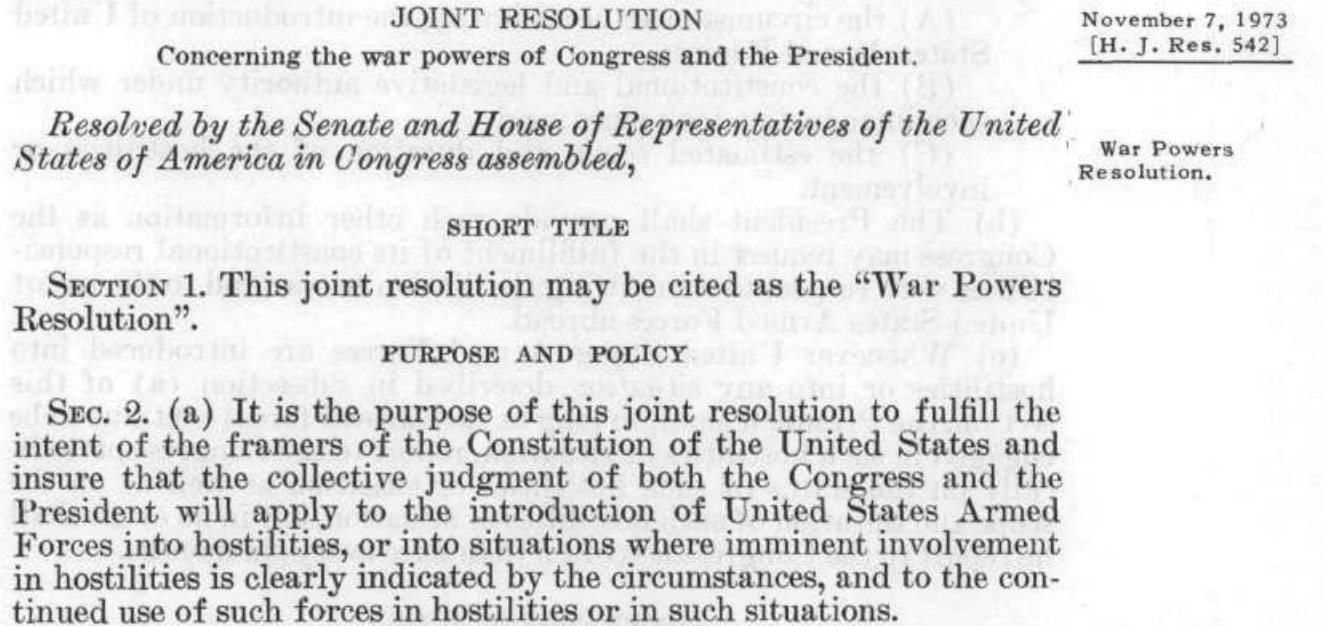
Generally, most legal experts and commentators agree that presidential uses of force can align with the Declare War Clause. For example, presidents may use military force if Congress has provided specific authorization. This can take the form of a formal declaration of war or a more informal statutory authorization. For instance, following the September 11, 2001, attacks, Congress authorized the President to use force against those responsible and their supporters. Authorizations can be specific (e.g., Congress authorizing force against Iraq under President George W. Bush) or more open-ended (e.g., authorizing force to protect U.S. interests and allies in Southeast Asia, which led to the Vietnam War). In order to correct what it saw as presidential war power overreach, the U.S. Congress (remember the Congress?) passed the The 1973 War Powers Resolution to restrict the President's ability to commit troops without congressional approval, requiring withdrawal within 60 days unless authorized by Congress.
Core Requirements for the President in War Powers Act (1973)
Consultation: Before deploying troops into hostilities or imminent danger, the President must consult with Congress "in every possible instance".
48-Hour Reporting: If forces are deployed without a declaration of war, the President must submit a report to Congress within 48 hours, outlining the circumstances, authority, and expected duration of the action.
60-Day Time Limit: If Congress does not declare war or authorize the action within 60 days, the President must withdraw the troops. An optional 30-day extension is allowed for safe withdrawal.
According to the War Powers Act, since the War on Iran began on February 28, the president has until April 29, 2026 to withdraw troops.
What do you think will happen? Are we keeping our republic? What would Framers say about the war in Iran?
Here are some pesky questions for students to answer about the passage above. And there’s a key!
And here is a great lesson about The War Powers Act of 1973.
War Powers Resolution Lesson
$0.00
This lesson was made with care! Your students can learn about the crazy idea called separation of powers!